Choosing a commercial chocolate mold starts with the finished product—not the mold. Your target chocolate weight, dimensions, segmentation, packaging, production volume and equipment determine which format makes sense.
This guide explains how to compare commercial chocolate molds without turning the buying process into guesswork. It focuses on mold selection and production fit. For detailed bar weights, ounce equivalents and cavity dimensions, use the Chocolate Bar Mold Size Guide. For production math, use our Chocolate Mold Calculator. For proprietary shapes, logos or dimensions, see our Custom Chocolate Mold program.
Quick decision guide
- Making standard chocolate bars? Start with our Chocolate Bar Molds.
- Making molded chocolate pieces or geometric shapes? Browse Polycarbonate Chocolate Molds.
- Need your own logo, dimensions, segmentation or shape? Use a Custom Chocolate Mold.
1. Start with the finished chocolate
Before comparing molds, define the chocolate you need to produce. The most useful starting specifications are finished weight, overall dimensions, shape, thickness and whether the piece is solid, filled or segmented.
A mold with the right overall dimensions but the wrong depth can produce a very different finished weight. Likewise, two bars with similar weights can have very different packaging footprints. Commercial buyers should evaluate the complete cavity geometry rather than choosing by gram weight alone.
2. Choose the mold material for the process
Rigid polycarbonate molds are commonly chosen when a production team wants repeatable cavity geometry, crisp surface detail and a rigid mold format for chocolate bars and molded pieces. Flexible molds can be useful for products that benefit from a more flexible release method or for shapes that are difficult to demold from a rigid tool.
The best material is the one that matches the finished geometry and the way your operation fills, cools, handles and releases the product. If you already use trays, racks, cooling equipment or automated handling, check the mold footprint before purchasing.
If you are building a compact small-batch molding workflow, compare your mold dimensions and process with our 5.5L commercial chocolate tempering machine, which includes a vibration/work table for molded-chocolate production.
3. Compare cavity dimensions—not just weight
Chocolate weight is useful for planning, but cavity dimensions tell you whether the finished product will fit your packaging and brand format. Compare cavity length, width and depth with the dimensions you actually need.
When a product listing includes an approximate finished chocolate weight, treat it as a sizing reference. Actual finished weight can vary with formulation, inclusions and fill level.
4. Understand bars per mold and cavities per mold
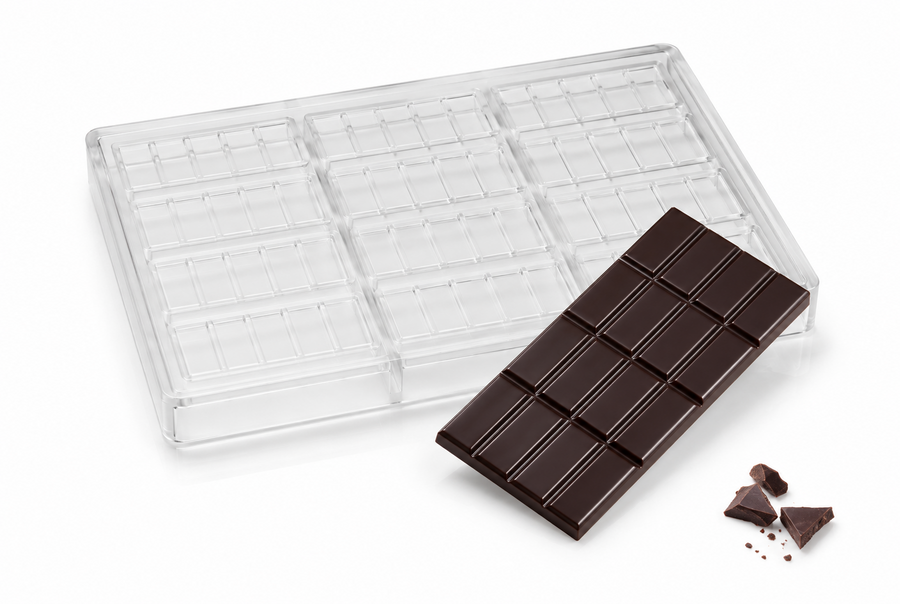
For production planning, one of the most important numbers is how many finished pieces each mold produces per cycle. A three-bar mold and a twelve-bar mold can have similar overall footprints but very different output per mold.
For example, a 3-bar mold produces three finished bars per fill cycle, while a 12-bar format produces twelve. The right choice depends on the target bar size as well as your available filling and cooling capacity.
5. Segmentation matters
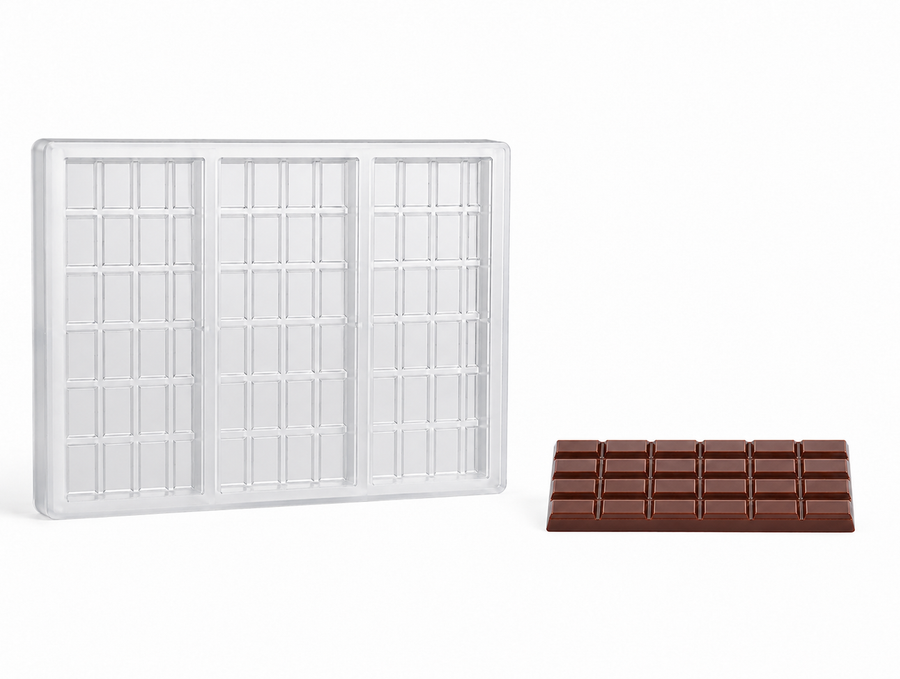
For chocolate bars, segmentation is part of the finished product design. A 24-piece bar, 16-piece bar and 10-piece bar can serve different packaging, portioning and branding goals even when they are made in similarly sized commercial molds.
When comparing segmented bars, check both pieces per bar and the actual cavity dimensions. Do not assume that a larger segment count automatically means a larger bar.
6. Check the overall mold footprint
Many of our commercial polycarbonate formats use an overall footprint around 275 × 175 mm, but mold thickness and cavity geometry vary by design. Always verify the listed dimensions of the exact mold you are considering.
If molds need to fit existing depositors, vibrating tables, cooling racks, trays or storage systems, use the overall mold dimensions as an equipment-fit check before ordering in volume.
7. Stock, bulk made-to-order or custom?
Stock molds are the fastest route when an existing cavity already matches your product. They are especially useful for testing a new bar weight, expanding a product line or launching without custom tooling.
Bulk made-to-order is appropriate when the mold design already exists but you need production quantities beyond current stock.
Custom molds are the right path when the finished chocolate requires proprietary branding, logo detail, unique dimensions, special segmentation or a shape that is not available in the standard catalog.
8. Compare current commercial formats
The table below shows several different ways a similar commercial mold footprint can be used. Always use the individual product page as the final specification source before ordering.
| Format | Output per mold | Segmentation | Cavity / bar dimensions | Reference capacity |
|---|---|---|---|---|
| 29g 24-Piece Bar | 3 bars | 24 pieces per bar | 130 × 28 × 7.4 mm | 23 mL per bar |
| 70g 24-Piece Bar | 3 bars | 24 pieces per bar | 143 × 70 × 6.5 mm | 55 mL per bar |
| 85g 16-Piece Bar | 3 bars | 16 pieces per bar | 145 × 66 × 7.8 mm | 67 mL per bar |
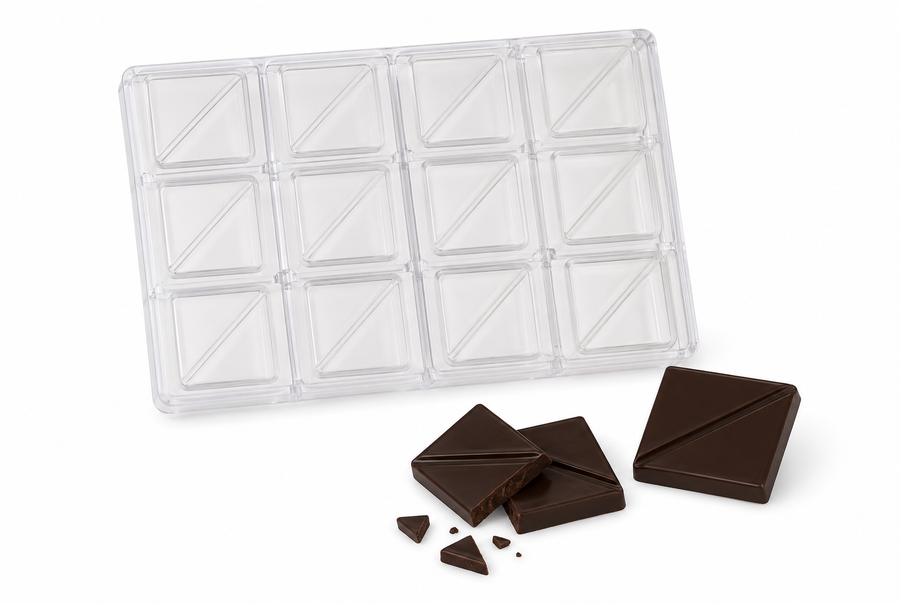
| 20g Square Breaker | 12 bars | 2 pieces per bar | 50 × 50 × 6.7 mm | 20g reference weight |
| 28g Square Chocolate | 15 pieces | Single molded pieces | 45 × 45 × 10 mm | 22 mL per cavity |
9. Plan production output before buying mold quantity
Mold count should come from the production target. Start with finished pieces required per batch or shift, divide by the number of pieces each mold produces, then account for how many fill-and-release cycles you expect each mold to run.
Instead of doing this manually, use the Chocolate Mold Calculator to estimate chocolate requirements, output per cycle, molds required and cycles needed.
10. Common buying mistakes
- Choosing by gram weight without checking cavity dimensions.
- Ignoring packaging dimensions until after the mold is ordered.
- Confusing pieces per bar with bars per mold.
- Buying too few molds for the intended production target.
- Assuming every mold with the same footprint has the same depth or output.
- Moving to custom tooling when a stock format already matches the product.
- Ordering a stock format that is close—but not actually compatible—with an established wrapper or package.
Commercial chocolate mold checklist
- Target finished chocolate weight
- Finished length, width and thickness
- Solid, filled or segmented format
- Pieces or bars required per batch
- Packaging dimensions
- Overall mold footprint required by equipment
- Desired bars or cavities per mold
- Stock, bulk or custom requirement
Frequently asked questions
What is the best mold for commercial chocolate bars?
The best mold is the one whose cavity dimensions, finished weight, segmentation, mold footprint and output fit your product and production process. For standard bars, start with the Chocolate Bar Molds collection.
How many chocolate molds do I need?
That depends on pieces per mold, target output and the number of production cycles. Use the Chocolate Mold Calculator for a production estimate.
Should I choose a stock or custom chocolate mold?
Use a stock mold when an existing cavity matches your required product. Choose custom when you need proprietary branding, dimensions, shape or segmentation that the stock catalog cannot provide.
Does cavity volume equal finished chocolate weight?
No. Volume is a geometric capacity measurement. Finished weight depends on the chocolate formulation, inclusions and fill level. Use a known finished weight whenever you have one; otherwise use volume-based calculations only as planning estimates.
Choose your next step
Shop Chocolate Bar Molds · Shop Polycarbonate Chocolate Molds · Use the Chocolate Mold Calculator · Start a Custom Chocolate Mold